Amazon A+ Content Examples: 5 Real Premium A+ Pages, Module by Module
Not mock-ups: five A+ pages from real customer listings in five categories, what each module does, and the order they all share.
What the best A+ examples have in common
Amazon A+ Content examples that convert answer buyer questions in a fixed order: promise (a hero with one clear benefit), proof (materials, ingredients or specs up close), use (the product in real situations), choice (a comparison or size chart) and brand. Each module answers one question, the text stays readable on a phone, and nothing promotional gets in the way of approval.
Thorsten Müller, co-founder of HORAiZON, 12 years in Amazon marketing · Last checked 6 November 2026
All five pages below were created with HORAiZON ONE for real customer listings on Amazon.de, so the text inside the images is German; this page translates what matters. Scroll inside each image to see the whole page as shoppers see it.
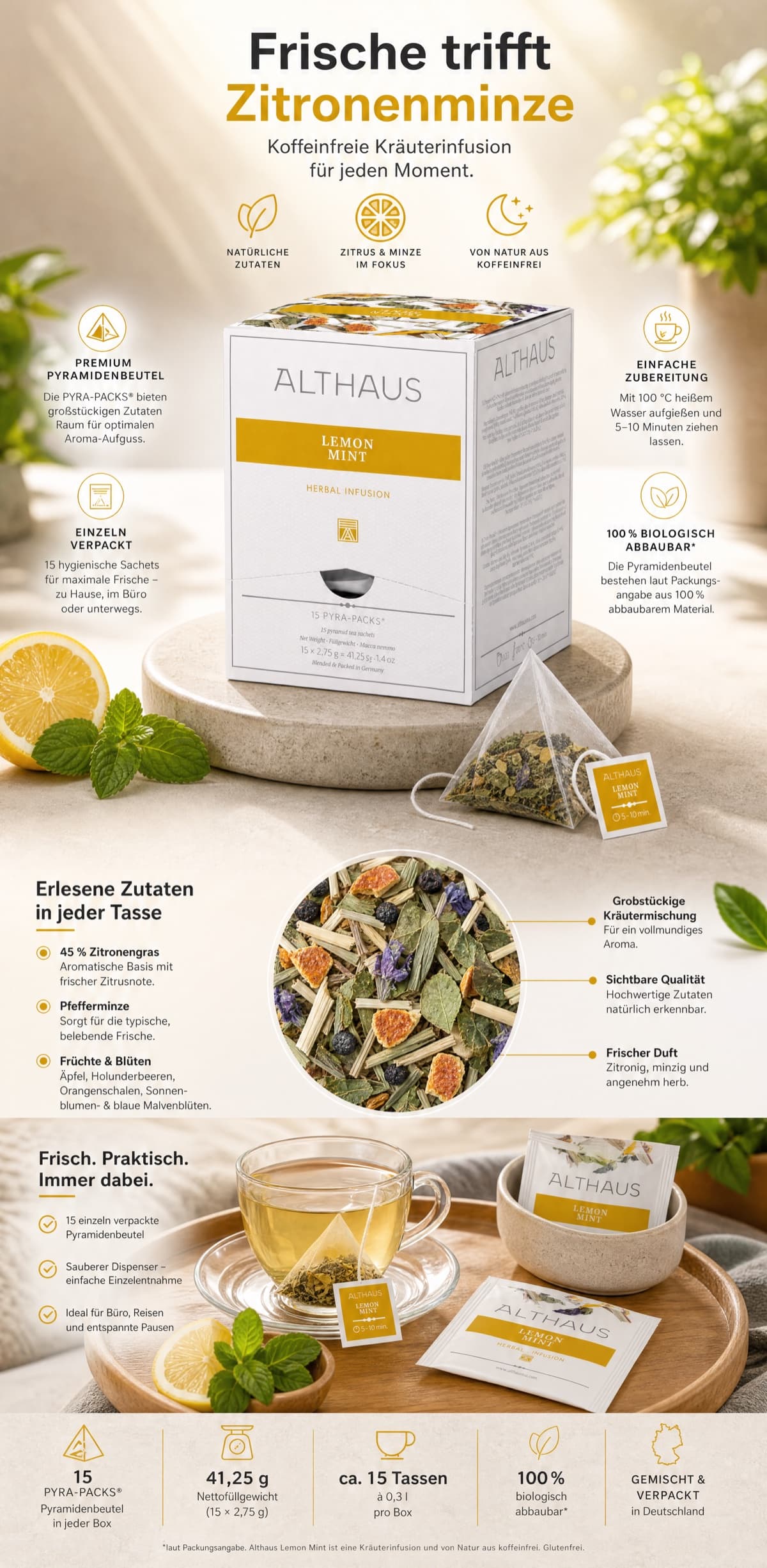
Example 1 · Food & drink
Herbal tea: answer "how do I make it" before anyone asks
- Hero: Headline "Freshness meets lemon mint", three icon claims: natural ingredients, citrus and mint, naturally caffeine-free.
- Product with callouts: The box in the center, four callouts around it: pyramid sachets, individually wrapped, brewing (100 °C, 5–10 minutes), biodegradable "according to the packaging".
- Ingredient close-up: A zoomed tea blend with the recipe: 45% lemongrass, peppermint, fruits and blossoms.
- Usage scene: Cup, sachet and tray: office, travel, a break. Three short checkmarks.
- Facts strip: 15 sachets, 41.25 g net weight, about 15 cups, 100% biodegradable, blended and packed in Germany.
Why it works: Food shoppers want to know what is in it and how to prepare it. Every number here would otherwise turn up as a customer question. Note the footnote on the biodegradability claim: it is attributed to the packaging, which keeps it reviewable.
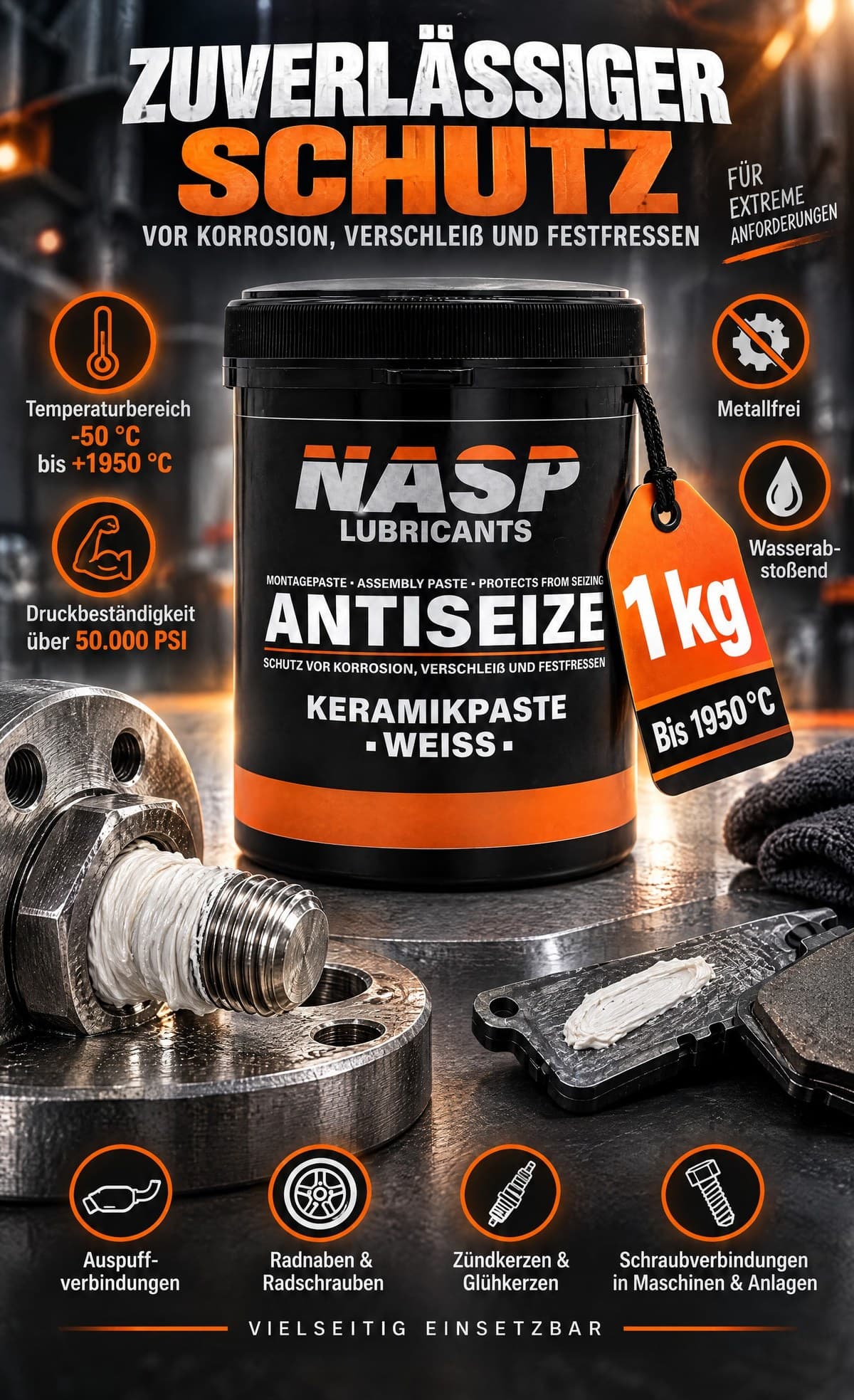
Example 2 · Automotive & industrial
Ceramic anti-seize paste: numbers first for technical buyers
- Hero with specs: "Reliable protection against corrosion, wear and seizing" on a dark workshop background, product tub and a 1 kg tag.
- Spec callouts: Temperature range −50 °C to +1,950 °C, pressure resistance over 50,000 PSI, metal-free, water-repellent.
- Application icons: Exhaust connections, wheel hubs and bolts, spark and glow plugs, bolted joints in machines.
Why it works: Mechanics and engineers buy on specs and fit. One dense, high-contrast module that answers "does it handle my temperature" and "can I use it on my part" does more than five mood images.
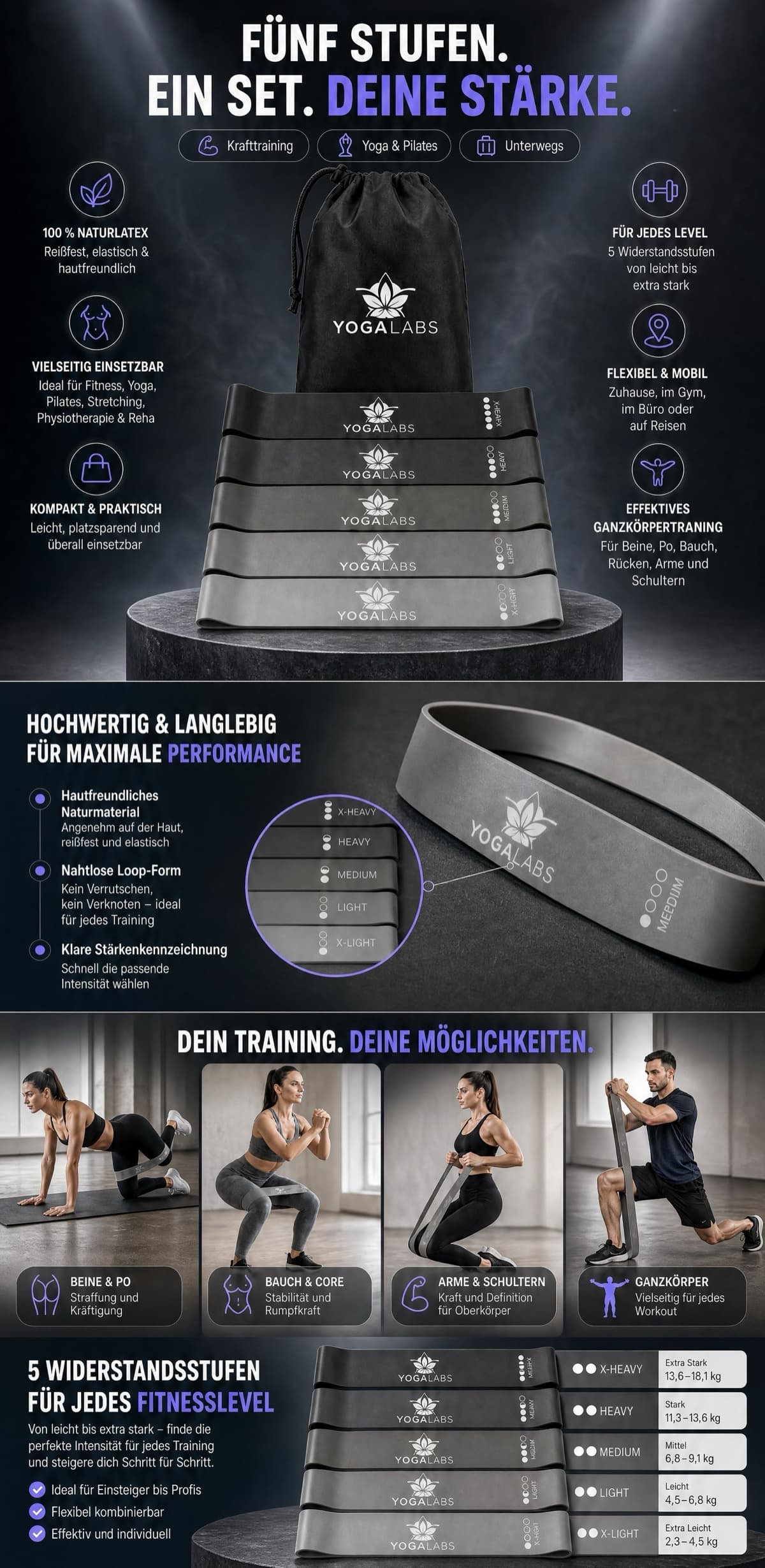
Example 3 · Sports & fitness
Resistance bands: a strength chart that prevents the wrong purchase
- Hero: "Five levels. One set. Your strength." Six benefits around the product: natural latex, versatile, compact, every level, mobile, full-body.
- Material close-up: Skin-friendly material, seamless loop, clear strength labels, with a zoom on the printed level marks.
- Use-case grid: Four exercise photos by body area: legs and glutes, core, arms and shoulders, full body.
- Resistance table: Each band with its range, from extra light (2.3–4.5 kg) to extra heavy (13.6–18.1 kg).
Why it works: Whenever a product comes in levels, sizes or strengths, the comparison is the module that sells. It also cuts returns from people who picked the wrong one.
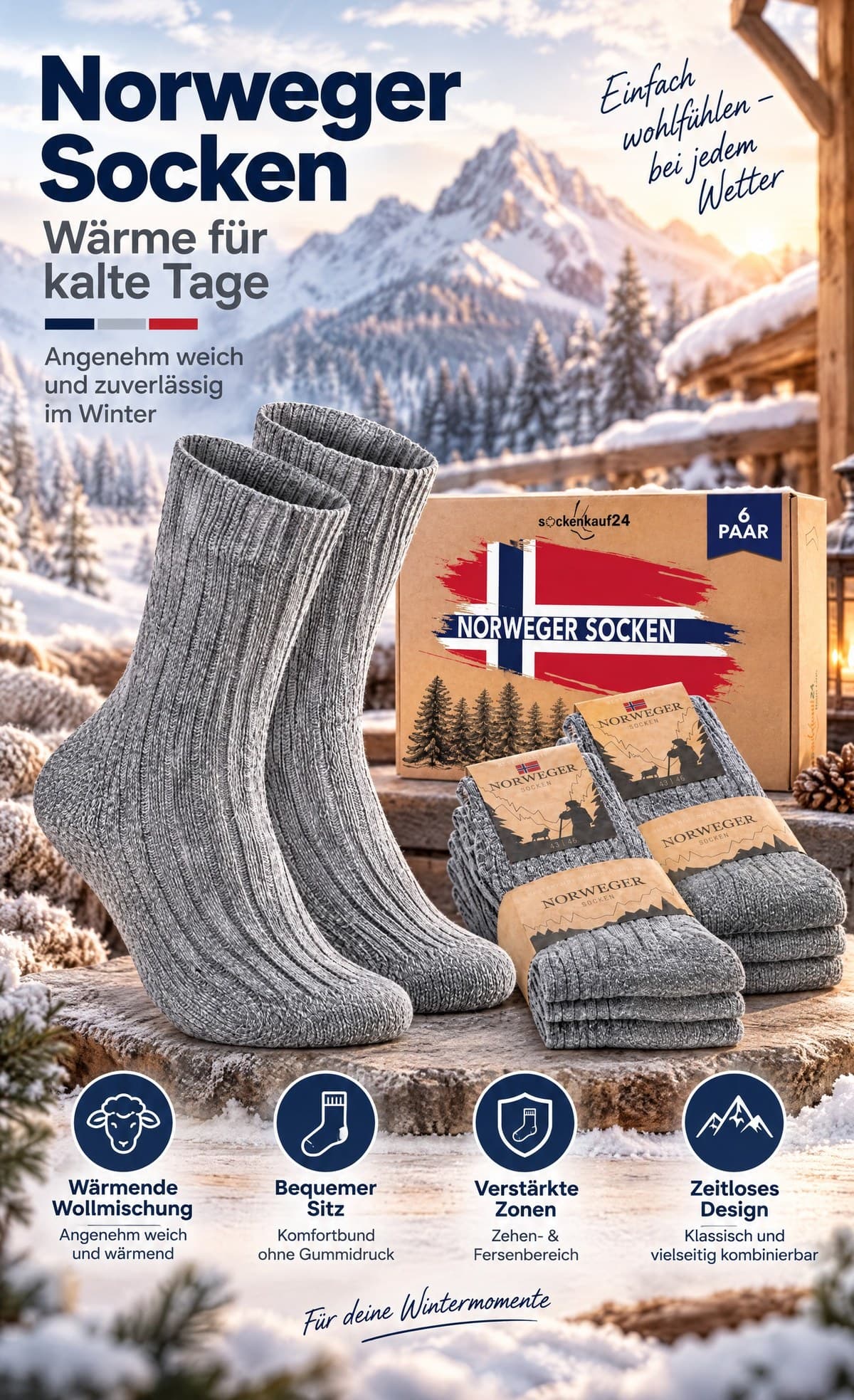
Example 4 · Apparel
Wool socks: mood and season, then concrete construction details
- Seasonal hero: "Norwegian socks, warmth for cold days" in a winter mountain scene, the 6-pair box next to the product.
- Benefit icons: Warming wool blend, comfort cuff without elastic pressure, reinforced toe and heel, timeless design.
Why it works: Apparel A+ can sell a feeling, but it still needs the facts that decide the purchase: material, fit and durability. The icon row puts them under the mood image, where a mobile shopper sees them next.
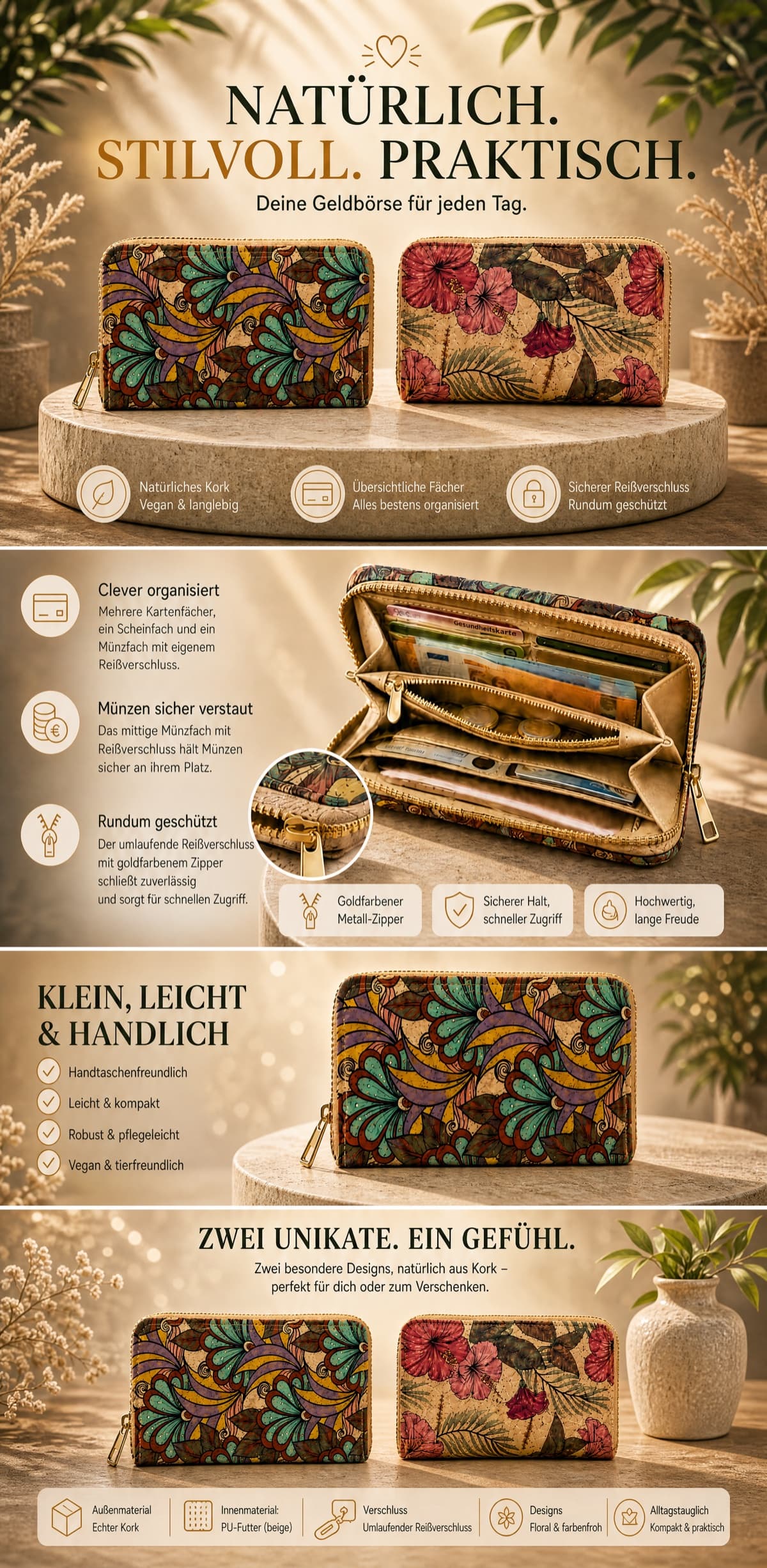
Example 5 · Accessories
Cork wallet: show the inside and the variants
- Hero: "Natural. Stylish. Practical." Both designs side by side, three claims: natural cork, organized compartments, all-round zip.
- Inside view: The open wallet with callouts for card slots, note compartment and the zipped coin pocket.
- Size module: "Small, light and handy" with four checkmarks: fits a handbag, lightweight, robust, vegan.
- Variants and materials: "Two designs. One feeling." plus a facts strip: cork outer, PU lining, zip closure, designs, everyday use.
Why it works: For anything with an inside, the open view is the module shoppers look for. Showing both designs together turns "which one?" into a choice between your products rather than a reason to leave.
The module order behind all five
| Step | Buyer question | Good module choices |
|---|---|---|
| 1. Promise | Is this for me? | Premium Full Image or Standard Image Header with one benefit and 3 icon claims |
| 2. Proof | Is it good / will it last? | Hotspots or a close-up with callouts: material, ingredients, specs |
| 3. Use | How and where do I use it? | Navigation carousel or a 3–4 image grid of real situations |
| 4. Choice | Which one should I buy? | Comparison table or size and strength chart |
| 5. Brand | Who makes it? | Facts strip (origin, contents) and Brand Story above A+ |
- Write each module's headline as the answer to its buyer question.
- Keep text inside images to a few large words; phones show most A+ views.
- Put numbers where shoppers compare: temperatures, weights, levels, counts.
- Attribute claims you can't prove yourself ("according to the packaging") or leave them out.
- No prices, discounts, guarantees, links or competitor names: they get A+ rejected.
Specs, eligibility and the 2026 rule changes are in the Amazon A+ Content guide; video, hotspots and carousels are covered in the Premium A+ guide.
Get a Premium A+ page like these
HORAiZON ONE builds the A+ page together with your copy and image gallery and uploads it to Amazon through the official SP-API after you approve it.
Start free now300 free credits · No credit card
The five A+ examples at a glance
- Herbal tea (food & drink)
- 5 blocks: hero with 3 claims, product with callouts, ingredient close-up, usage scene, facts strip
- Ceramic anti-seize paste (automotive)
- 3 blocks: hero, temperature and pressure specs, application icons
- Resistance bands (fitness)
- 4 blocks: hero with 6 benefits, material close-up, exercise grid, resistance table in kg
- Wool socks (apparel)
- 2 blocks: seasonal hero, construction benefits
- Cork wallet (accessories)
- 4 blocks: hero with both designs, inside view, size module, variants and materials
- Created with
- HORAiZON ONE, AI platform for Amazon listing optimization
- Marketplace
- Amazon.de (German-language A+)
A+ Content examples: FAQ
What makes a good Amazon A+ Content example?
A good Amazon A+ Content example answers one buyer question per module: what it promises, what it is made of, how it is used, which variant to choose. Good A+ pages follow that order, use few large words that stay readable on a phone, and avoid prices, promotions and unverifiable claims.
How many modules should an A+ page have?
An Amazon A+ page should use what the product needs, up to the limit: 5 modules for Basic A+, 7 for Premium A+. The examples on this page use between two and five full-width blocks; more modules only help if each answers a different question.
Are these A+ examples from real Amazon listings?
Yes. All five A+ Content examples were created with HORAiZON ONE for real customer listings on Amazon.de, which is why the text in the images is German. The module structure works the same way on Amazon.com and Amazon.co.uk.
Can I copy an A+ Content template?
Copy the A+ structure, not the design: promise, proof, use, choice, brand. A+ Content Manager does not offer finished templates, but you can reuse your own modules across ASINs of the same product line.